From Posted Notice to Public Update: A Short History
Trace how public notices moved from boards and newspapers to broadcast and online channels, and see what each change made visible or left behind.
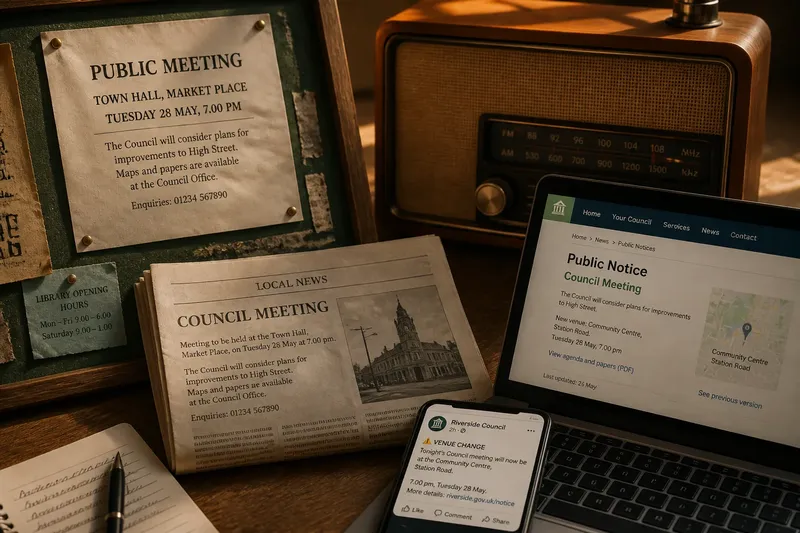
The common mistake in telling the history of public notices is to treat each new format as a simple improvement. Public notice history is less tidy: a printed sheet, a newspaper announcement, a broadcast and a web page each made civic information visible in different ways, while leaving different traces behind.
These formats did not replace one another neatly. They overlapped, and institutions still use several at once. Their history is a record not only of changing technology, but of who could encounter an announcement and whether its wording endured.
How did printed notices make information local?
Before public institutions could publish notices online, paper sheets on town hall doors, library boards, market walls and station noticeboards offered a direct, local route. Someone visiting those places might see an announcement without knowing which office had issued it. The board made public information part of the setting where people gathered or carried out daily tasks.
Its reach was bounded by place. A notice at a town hall did little for someone who could not visit, and crowded boards made individual sheets easy to miss. Paper could be covered, removed or damaged. An institution might retain a filing copy, but a passer-by could not assume that the posted version would remain available.
The medium encouraged brief wording: the subject, the relevant location, a date or a contact point. That concision helped a reader grasp the immediate matter, but left fuller explanations to another document or conversation.
What changed when newspapers carried official notices?
Newspapers took announcements beyond the building where they were posted. A notice might appear alongside local reporting and reach readers who had not planned to visit a public office. A dated issue also fixed the wording in print, making that edition a possible record after the notice had been taken down.
But publication depended on the newspaper’s circulation and on readers noticing a small, often formal item among other material. The printed notice could preserve an announcement without preserving its supporting map, explanatory papers or later alterations. If a date or detail changed, another announcement could be needed; a reader then had to distinguish the versions.
The newspaper broadened the audience, but did not necessarily provide the background needed to understand the decision. Its printed page was a record of what appeared there, not a complete file of the institution’s work.
Why were broadcasts both immediate and fleeting?
Radio and television added spoken announcements to the public information mix. A local bulletin could bring a meeting, closure or disruption to people who were not reading a paper or visiting an official building. The announcement could arrive in the flow of ordinary news rather than requiring a deliberate search.
Yet a spoken detail is easy to miss. A listener may not catch a place name or date, and a short bulletin may offer no map or document to inspect. Unless a recording is retained and made accessible, the announcement passes without leaving an easy public record. Broadcasts made information timely; they did not automatically make it retrievable.
How did web pages change the notice?
Institutional websites brought notices together with maps, forms, contact details and related papers. Searchable text and links could lead a reader from a short announcement to more context. Unlike a printed issue, a web page could also be changed as circumstances shifted.
That ability to revise a page introduced a new ambiguity: a reader seeing the current text might not know what appeared before. A visible revision note or an archived version could show the page’s history; without one, a useful update might obscure the earlier announcement. The web made information easier to amend, but the record depended on how the institution handled those changes.
Discoverability mattered too. A page tucked several menus deep might be online but hard to encounter. Clear titles and descriptive links helped people identify the relevant notice without already knowing an internal department’s name.
What did social platforms add, and what did they leave out?
Platforms such as Facebook and X offered a quick way to circulate a short alert. Residents could share a post, while an institution could use it to direct attention to a fuller notice. The format suited reminders and urgent changes, but a post might reach only part of an audience, lose its link when copied, or become difficult to retrieve later.
Imagine a council has printed a meeting notice for the town hall, then learns that the room is unavailable. It posts a correction on Facebook and updates the notice page with the new venue and a note explaining the change. Readers who see the post can follow its link to the fuller record; those with only a paper copy still have the original venue. The two channels serve different needs, and the institution’s next decision is whether to put a replacement notice on the physical board as well.
What questions help explain public notice history?
When did public notices move online?
There is no single date at which printed notices gave way to web pages. Institutions adopted websites at different times, and online publication developed alongside newspapers, physical postings and broadcast announcements.
Why did printed notices remain useful?
A printed notice could be encountered in a shared physical place without a reader needing an account, device or web address. Its limits were also physical: it could be missed by anyone who did not visit that location.
Did social media replace official notices?
Social posts made short announcements easier to share, but they were not the same as a complete, lasting public record. Their role depended on whether they linked to fuller information and whether that information remained available elsewhere.
What does the history reveal about access?
Each format offered a different route into public information, shaped by location, circulation, timing or discoverability. No format reached every reader or preserved every detail by itself.
Which parts of this history still shape public notices?
The older formats remain useful reference points because they show that publication and access are not identical. A sheet can be posted but overlooked; a broadcast can be heard but forgotten; a web page can be updated but lose the trail of its earlier wording. These are not reasons to dismiss any one channel. They are reminders that each has a distinct public role.
For anyone tracing public notice history, the most revealing question is what a format allowed a reader to do: encounter an announcement locally, keep a dated issue, hear an immediate alert or follow a link to supporting material. That question keeps the story grounded in civic experience rather than in a simple procession of newer technologies.